History of Venetian Masks
Origin of Venetian Carnival
by Michel Tieuli. BSc., 2006
The word carnival (Italian: carnevale) possibly comes from the Latin carnem levare or carnelevarium, which means to take away or remove meat!. A more probable etymology for the word carnevale may be derived from the Latin carne + vale, meaning "farewell to meat". Developed around the Roman Catholic festival of Lent (Quaresima - derived from the Latin term Quadragesima, or "the forty days"), carnevale was associated with the pre-Lenten festivals practiced on and around Martedí Grasso (Shrove Tuesday) or Mardi Gras (trans. Fat Tuesday).
Traditionally, the forty days in Lent would mark a season of sorrowful reflection, fasting and abstinence from fruit, eggs, meat and dairy products. Although carnevale is first mentioned in documented sources in 1092 during the Dogate of Vitale Falier, the history of Venetian carnival is thought to have originated from an annual celebration of Doge Vitale II Michiel's victory over Ulrich II of Treven (von Treffen), Patriarch of Aquileia in 1162.
Ulrich II was taken prisoner together with 12 vassals who were allied to the feudal Friulians in a rebellion against the Republic's (Italian: Serenissima Repubblica di Venezia) control over the territory of Grado. Ulric was eventually released on the condition that he pay an annual tribute to Venice in the form of 12 loaves of bread, 12 pigs and 1 bull. During this period a tradition began of slaughtering a bull (representing Ulric) and 12 pigs in the Piazza di San Marco around Shrove or Fat Thursday (Venetian: Zioba Grasso) to commemorate the victory.
Edward Muir, Civic Ritual in Renaissance Venice (Princeton: Princeton University Press, 1981)
The first documented sources, mentioning the use of masks in Venice can be found as far back as the 13th century. The document describes the the practice of masked men throwing scented eggs at ladies and its prohibition by the council (Venetian Laws, 1268 May).
Additionally, the Venetian calendar celebrated the new year (Venetian: El Cao de Ano or o Bati Marso) on the 1st March and was an official festival of the Serenissima Repubblica.
The Bauta (La Bauta)
The etymology of Bauta is uncertain: Tramatar believed it may be derived from the German verb "behüten", that is to protect (the wearer).
Alternatively, Durante and Turato refer to the Veneto-Italian "bau-bao", which was a bogeyman like character used by adults as a method to scare children (Danilo Reato).
"Se non stai bravo viene il babau e ti porta via." - (trans. "if you do not behave, the babau will come and take you away").
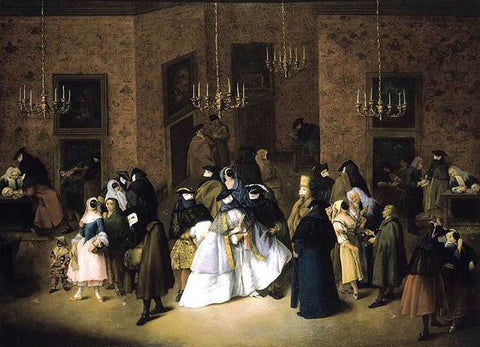
The original elements of the Bauta disguise comprises of the typically shining white face-shaped mask ("larva" or "volto"), a black cape or veil of silk, a cloak (tabarro) or mantle, and a three-cornered ("tricorne") hat. The Bauta was worn by both Venetian ladies and gentlemen alike.
Danilo Reato, Le Maschere Veneziane, Arsenale Editrice, 1988, pages 43, 103.
The Moretta
The Moretta or Servetta Muta (trans: dumb maid-servant) is a black velvet, oval shaped mask that was worn by Venetian ladies. Covering all but the outer edge of the face, the Moretta was secured to the wearer by way of a small bit that was held in place between the teeth.
By the 18th century the use of the Bauta and Moretta masks to conceal the identity of ladies and gentlemen in the gambling houses (Ridotti) of Venice had become commonplace. Many paintings of the crowded parlours of the public ridotti and coffee houses of this period were depicted by the artists Pietro (Falca) Longhi and Giovanni Antonio "Gianantonio" Guardi.
Commedia Dell'arte
Commedia Dell'arte (trans. "comedy of professional artists" or "comedy of humours"), also known as Extemporal Comedy, was a form of improvisational theatre which began in the 16th century and continued to be widely popular up until the 18th century.

The performances were improvised by each theatre company around a repertory of stock conventional situations, which tended to revolve around the topics of adultery, jealousy, love and old age.
Abadea is the fool who laughed at nothing.
Arlecchino (French: Arlequin, English: Harlequin) typically depicted in multicoloured costume comprised of diamond shaped patterns. Painted by Antoine Watteau,
Brighella (French: Brighelle), a cunning and mischievous servant. He is associated with Bergamo.
Colombina (French: Columbine), maid-servant counterpart of Arlecchino (Harlequin).
Il Capitano (the Captain), Cap. Bonbardon, Mala Gamba, Belavita & Zerbino are just some examples of the many forms of the character and Italian masks depicted in the series of 24 etchings, Balli di Sfessania (cerca. 1621) by Jaques Callot.
Il Dottore (the Doctor, usually called Dottore Balanzone, Balordo or Graziano). He is associated with Bologna.
Innamorata (the Lover) is the leading woman. She wore no mask (see innamorati).
Innamorato (the Lover) is the leading man. He wore no mask (see innamorati).
Isabella (Lucinda, Cornelia, Silvia, Rosaura) is Pantalone's daughter.
Mezzetino (equivilent of Mezzetin the French figure), painted by Antoine Watteau).
Pagliaccio (the Clown).
Pantalone or Pantalone dei Bisognosi, (French: Pantalon, English: Pantaloon). He is a Venetian Merchant
Pedrolino (or Pierino, most commonly nowadays known as French: Pierrot)
Pulcinella (related to the Italian: pulcino or chick) is a crooked-nosed hunchback. He was the model for Punch in the English puppet theatre Punch and Judy. He is associated with Naples.
La Ruffiana (Old Woman) is usually a mother or gossipy townswoman who intrudes into the lives of the Lovers
Scaramuccia (French: Scaramouche) a roguish adventurer and swordsman who replaced Il Capitano in later troupes.
Zanni is a threadbare old servant from Bergamo. He is associated with Bergamo & Venice.
War of the Fists (Battagliole) & the Gangs of Venice
In 1369 the Great Council encouraged the annual battagliola universale held on the first day of every new year (Museo Correr, Codici Cicogna 3161, 1670/36). However, the battagliole were outlawed by the Council of Ten in 1505, but pre-arranged fights continued to be organised to celebrate the arrival of foreign dignitaries and diplomatic missions to Venice throughout the sixteenth century. (Consiglio dei Dieci, proclami (CDP), filza 1, 12 Sept 1505)
Documented sources in the Museo Correr describe staged fights over particular bridges (ponte di guerra) or other areas - guerre di cane (wars of the sticks) and guerre dei pugni (wars of the fists) between the two leading factions of Venice, the Castellani: sailors and ship builders of the Venetian Arsenal (arsenalotti), who were associated with the districts of the Sestiere di Castello, San Marco and Dorsoduro, and the Nicolotti, fishermen and residents of San Polo, Cannareggio and Santa Croce. By the mid-1600s, the captains (caparioni) of the factions had limited the battagliole by mutual arrangement to a small number of locations, the bridges at San Barnaba (Ponte dei Pugni), Santa Fosca, and San Marziale (Museo Correr, Codici Cicogna).
Carnival Festivities & Games
During the period of carnival and other civic festivities the gangs would challenge each other in games such as the Ballo della Moresca & The Forze d'Ercole (Robert C. Davis, 1994, pp.vii + 232). These games commonly reflected various Venetian attributes and celebrated historical events. The theme of War Engines could be identified in the Macchina dei Fuochi (Machine of the flames), the Venetians' martial prowess in the storming of the walls at Aquileia by the Forze d'Ercole (strength of Hercules as Human Pyramids), battle in the Ballo della Moresca (Dance of the Moor), Law and justice in the Taglio della Testa del Toro (decapitating of the Bull) and peace in the form of the Volo dell'Angelo (Flight of the Angel or Turk).
The Forze d'Ercole consisted of two human pyramids, representing two popular factions of the town. These were the Castellani, (the inhabitants of districts of the Sestiere di Castello, San Marco and Dorsoduro who challenged the Nicolotti the inhabitants of Dorsoduro, near to the Church of San Nicolo dei Mendicoli, San Polo, Cannareggio and Santa Croce.
The Volo del Turco (the flight of the Turk), later called Il Volo dell'Angelo (the flight of the Angel) celebrates an exhibition that was originally given by a Turkish acrobat in the 16th century and later by volunteer Arsenalotti (from the Arsenale). From a barge docked by Saint Mark's, the Turk would climb a rope aided by a balancing rod to the top of the belfry of the belltower (Campanile) and then descend upside down along the Loggia Foscara of the Palazzo Ducale, giving flowers and reciting poems to the Doge.
Stocking Groups (Compagnie della Calza)
From the middle of the 15th century to the end of the 16th century, the organisation of the carnival festivities was delegated to the Compagnie della Calza. These associations of young Venetian nobles could be distinguished by their insignia and variously multicoloured patterned hose or calza.
Each stocking group had imaginative names which were inspired by and reflected particular virtues; Florid ones, United ones, and of the Concorde (Floridi, degli Uniti, e dei Concordi); Others, derived their names from contemporary professions, such as Ortolani, Zardinieri, Cortesi, Sempiterni and many others.
The aim of these groups was to create and prepare the entertainment and shows during the carnival. Between 1487 and 1565 there were at least 23 different stocking groups throughout Venice (Marin Sanudo, I Diarii di Marin Sanudo).
Museo Correr, Codici Cicogna 3161, Battagliola o guerra tra Nicolotti e Castellani, 1632-1673
Consiglio dei Dieci, proclami (CDP), filza 1, 12 Sept 1505
Robert C. Davis, Shipbuilders of the Venetian Arsenal: Workers and Workplace in the Preindustrial City, Baltimore: Johns Hopkins UP, 1991.
Robert C. Davis, The War of the Fists: Popular Culture and Public Violence in Late Renaissance Venice, New York and Oxford: Oxford UP, 1994. ISBN 0195084047, 9780195084047
Decline of Venetian Carnival
By the eighteenth century the wearing of masks by Venetians continued for six months of the year as the original religious association and significance with carnevale diminished. On October 17th, 1797 (26 Vendémiaire, Year VI of the French Republic) Venice became part of the Austrian-held Kingdom of Lombardy-Venetia when Napoleon signed the Treaty of Campo Formio. The Austrians took control of the city on January 18, 1798 and it fell into a decline which also effectively brought carnival celebrations to a halt for many years.
Recent History: Rebirth of Venetian Carnival
Carnevale was subsequently revived by a number of local artisans around 1979. Since then the annual "Carnival of Venice" has grown to become an internationally renowned event, celebrated by tourists and Venetians alike. Of the many different types of events celebrated each year during the carnevale the Gran Ballo della Cavalchina at the Teatro La Fenice (The Feniche Theatre) is considered as one of the most spectacular and exclusive of all the Venetian masked balls.
Hollywood & Contemporary Culture
More recently, Venetian carnival masks have been introduced to popular culture in the form of director Stanley Kubrick's Hollywood blockbuster film of 1999, "Eyes Wide Shut" (Tom Cruise & Nicole Kidman). Starring Tom Cruise, who plays the part of a New York City doctor. The plot revolves around the adventure of Cruise's character (Bill Hartford) as he learns of and then infiltrates a sinister group of wealthy hedonists engaged in a bizarre bacchanalian masked ball.
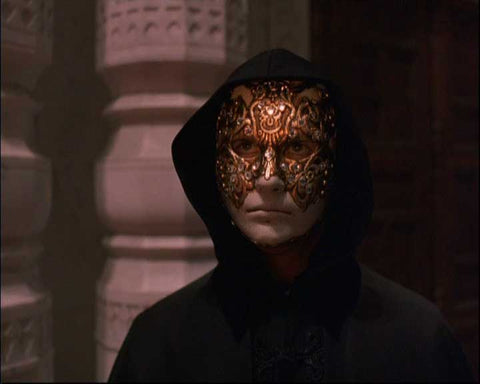
Photo: Copyright © 1999 Warner Brothers
Useful Information
The modern Venetian Carnival culminates on the Tuesday before Ash Wednesday (known as "Mardi Gras"), commencing two Fridays before the Tuesday. Venice carnival dates therefore vary annually, in step with Easter.